How Much Water Can an Automatic Irrigation System Save? A Farmer's Complete Guide
Water Is Becoming More Valuable Every Year. Are You Still Irrigating the Old Way?
Let's talk about something every farmer can relate to.
Over the last few years, farming has become more challenging than ever. Rainfall patterns have become unpredictable, ground water levels are dropping, irregular electricity supply, and labour availability is becoming a constant concern.
In such situations, every drop of water matters.
But here's something surprising.
Many farmers who believe they are using irrigation water carefully are actually losing a significant amount of it every season without realizing it.
Not because they are doing something wrong.
But because traditional irrigation methods often rely on assumptions, fixed schedules, and manual operation practices.
Do you know? The real question is not:
"Am I irrigating my crop?"
The real question is: "Am I irrigating my crop at the right time and with the right amount of water?"
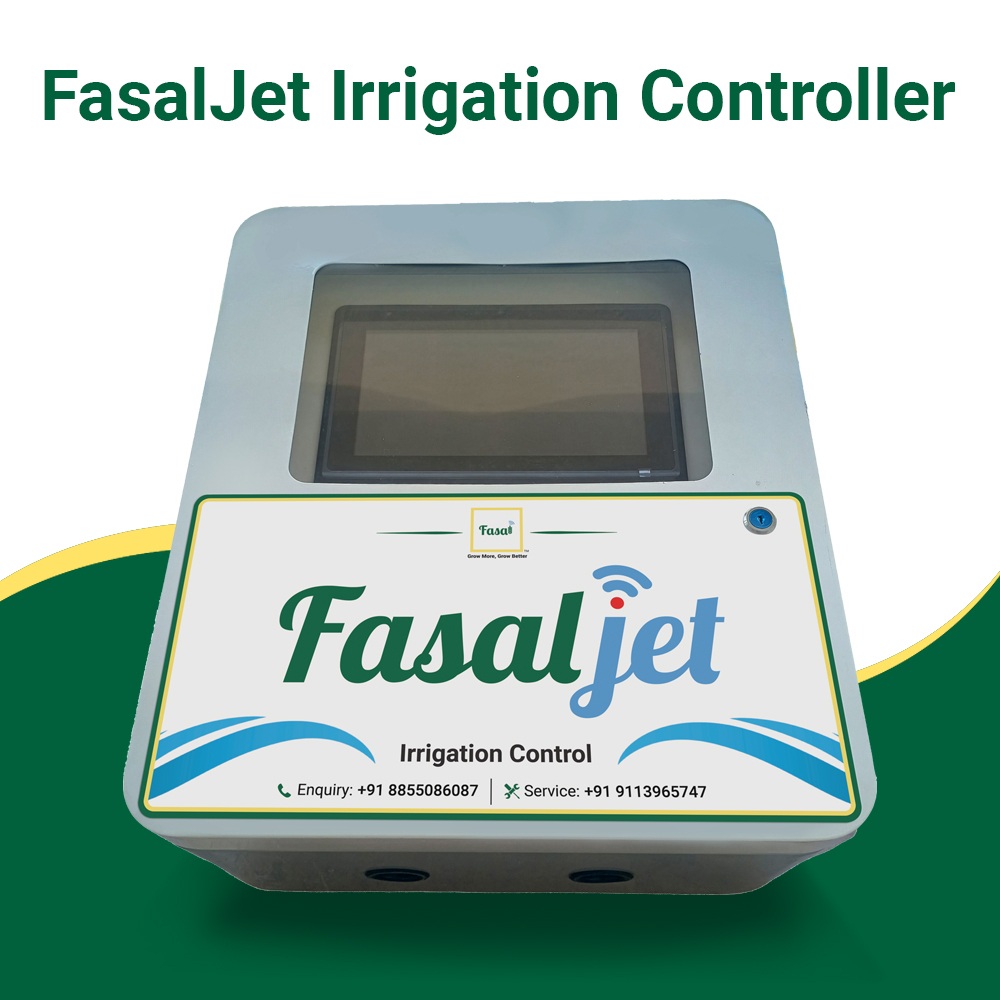
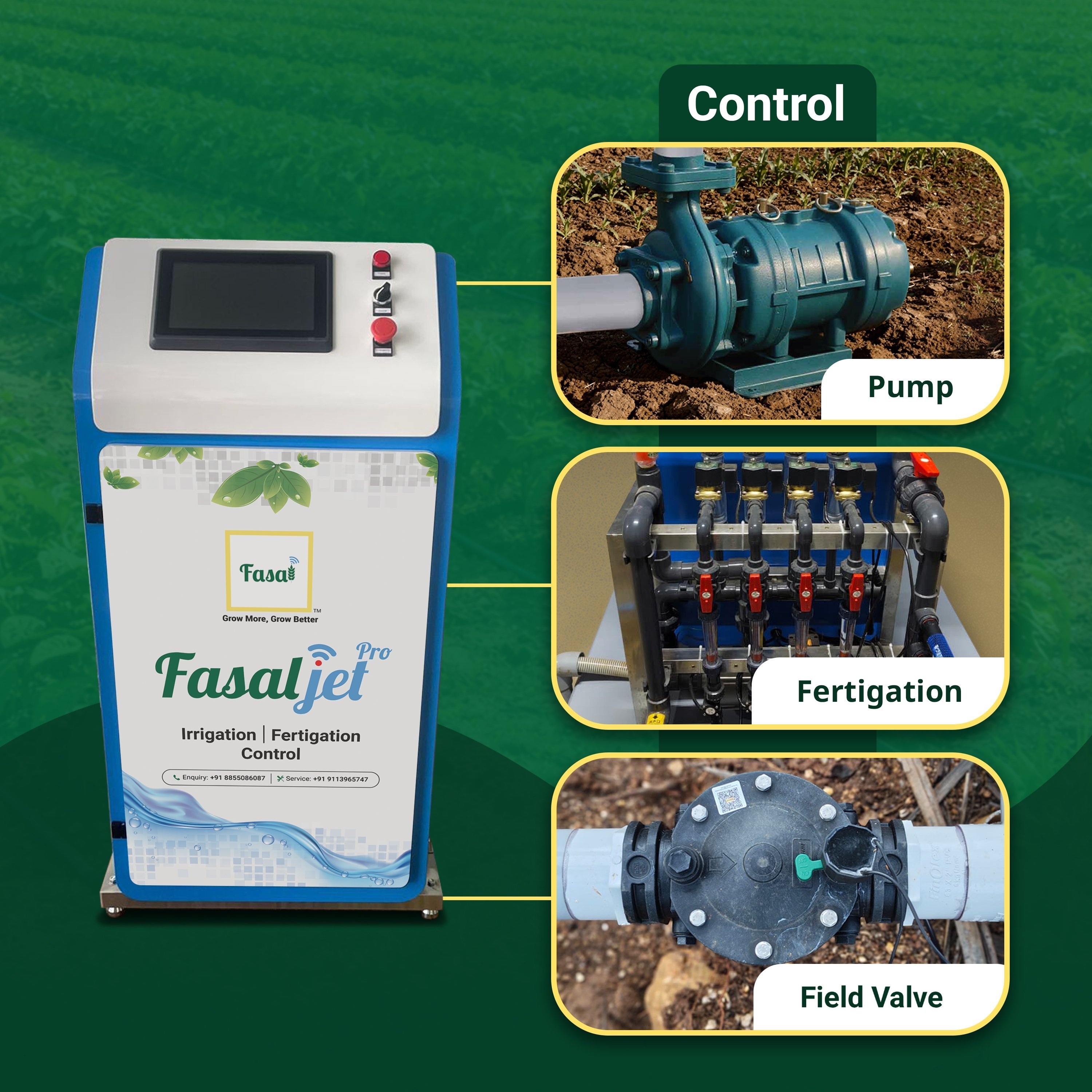
That's exactly where a Sensor-Based FasalJet - Automatic Irrigation System can make a huge difference!
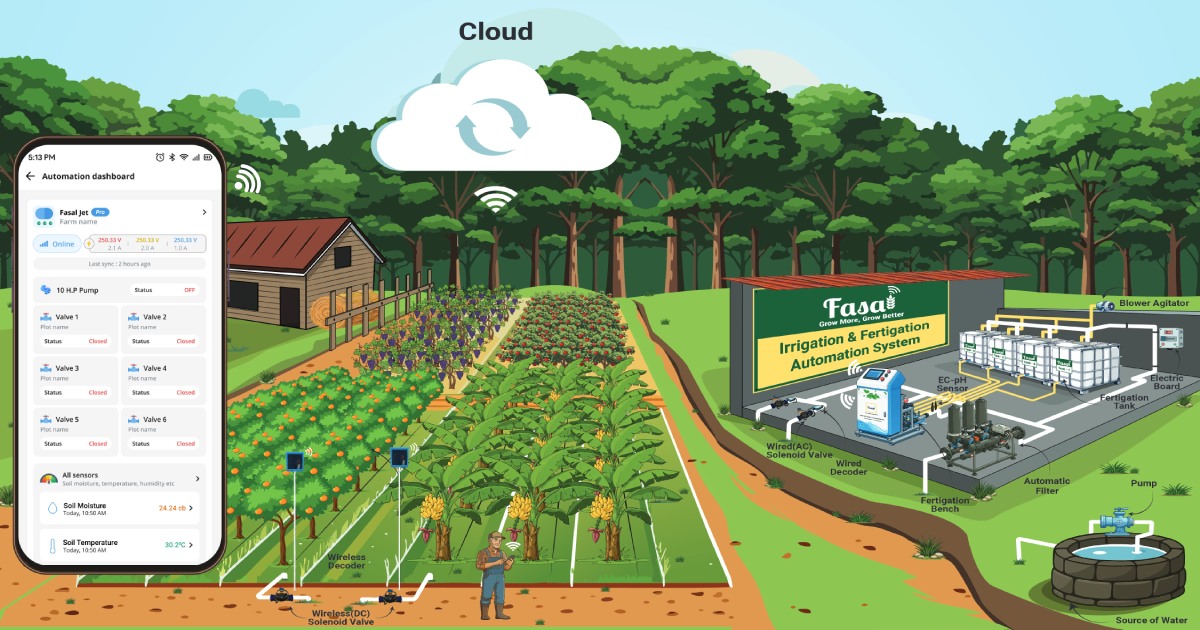
What is a Sensor-Based Automatic Irrigation System? A Sensor Based Automatic Irrigation System, also known as an Irrigation Automation System or Smart Irrigation System, is a technology that helps farmers automate irrigation based on sensor data & triggers instead of relying on guesswork & manual operations.
Thus, instead of manually turning pumps and valves on or off by going on farm, the system can:
• Start irrigation automatically when soil moisture level goes down as determined by the sensor • Stop irrigation automatically when soil moisture reaches optimum level as per sensor readings • Follow irrigation schedules set by farmer from mobile as per requirement • Reduce water wastage • Improve irrigation efficiency
Farmers can control irrigation remotely using a mobile phone on a realtime basis also. In simple words, it helps farmers provide the right amount of water at the right time to the crop.
So, How Much Irrigation Water Can Farmers Actually Save? This is the first question most farmers ask. Based on field studies and practical farm implementations, automatic irrigation systems can help to save water upto 20% compared to traditional manual drip irrigation methods.Let's understand this with a simple example.
Let’s Take an Example:
Suppose a farmer uses around 10 lakh litres of water during a crop season.With a Traditional Manual Drip Irrigation system, the farmer would use approximately 10,00,000 litres of water during the season.
With a Smart Irrigation System, water usage can be reduced to around 8,00,000 litres during the same season. This results in a potential water saving of up to 2 lakh litres per season. Now think about it.That is water that doesn't need to be pumped. That is water that doesn't increase your electricity bill. That is water that remains available when your crop needs it most.
Irrigation Method
Seasonal Water Usage
This is some text inside of a div block.
This is some text inside of a div block.
This is some text inside of a div block.
No items found.
Heading
Heading
The Problem Isn't Always Water Scarcity. It's Irrigation Management.
Let's be honest. No farmer intentionally wastes water.
Every farmer understands its value.
But traditional drip irrigation often creates situations where water gets wasted without anyone noticing.
Situation 1: Irrigating Because It's "Time"
Many farmers follow a routine. Every 2 days. Every 3 days. Every week.
The schedule may have worked in the past. But what if: • The soil already has enough moisture?
• The crop doesn't require irrigation today?
The irrigation still happens.
And over irrigation occurs, which leads to wastage of water, electricity, time, and labour.
Situation 2: Overwatering the Crop
Many farmers believe:
"More water means better growth."
Unfortunately, crops don't always agree. Too much water can:
• Reduce oxygen around roots
• Increase disease pressure
• Causes nutrient leaching
• Affect root development
• Reduce overall crop performance
Healthy crops need balanced irrigation, not excessive irrigation.
Situation 3: Labour Constraints
This is becoming a major issue across India.
Sometimes irrigation starts late
Sometimes pumps are left running longer than necessary
Sometimes labour simply isn't available
Over an entire season, these small inefficiencies can result in huge water losses.
Let's Look at a Real-Life Farming Situation
Imagine it's May.
The temperature has crossed 38°C.
You walk through your field and notice the topsoil looks dry.
Naturally, your first thought is:
"My crop needs water."
So you start irrigation. But what if the moisture available around the root zone is still sufficient? What if you're applying
more water than required? You won't notice the impact immediately. But across an entire season, those extra irrigation
cycles can add up to lakhs of litres of water.
And along with that:
• Higher electricity bills
• More pumping hours
• Increased nutrient loss
• Greater operational costs
This is exactly why many progressive farmers are moving towards Sensor BasedIrrigation Automation System. How Does a Sensor Based Automatic Irrigation System Save Water?
It Eliminates Guesswork
Instead of relying only on assumptions & irrigating fields manually, farmers can install this system on their farm which enables them to automatically irrigate their farms based on precise sensor data & triggers, thus irrigation happens only when needed without manual intervention.
It Prevents Over-IrrigationOne of the biggest reasons for water loss is overirrigating.Sensor Based Irrigation Automation helps deliver only the required amount of water.
No excess irrigation. No unnecessary pumping.
It Maintains Consistent Irrigation
Crops grow better when irrigation is timely and consistent.
When crops receive water exactly when required, they experience less stress and use water more efficiently.
Which Crops Benefit Most from Irrigation Automation?
Although irrigation automation can benefit almost any farm that has a drip irrigation system, it is particularly adopted among farmers growing following crops :
Fruit and Orchard Crops
• Pomegranate • Grapes • Mango • Guava • Citrus crops (Orange, Sweet Lime, Kinnow) • Avocado • Custard Apple • Dragon Fruit • Date Palm • Apple • Banana
Plantation Crops
• Coconut Oil • Palm
High Value Crops
• Sugarcane • Moringa
Vegetable Crops
• Tomato • Potato • Other drip-irrigated vegetables
These crops require precise irrigation and timely management for optimum growth and productivity. Ultimately, any farm using drip irrigation can leverage automation to make irrigation management more efficient, convenient, and data-driven.
Manual drip irrigation typically uses more water, requires more labour, and offers only moderate irrigation accuracy. It also lacks remote control features and carries a higher risk of overwatering. In contrast, an automatic irrigation system uses less water, reduces manual effort, provides more accurate irrigation, allows remote mobile-based control, and minimizes the risk of overwatering. As a result, automatic irrigation is generally more convenient and efficient to manage.
Water Saving Is Only One Benefit
Many farmers initially adopt irrigation automation to save water.But soon they discover several additional advantages.
Lower Electricity Bills
When pumps run only when necessary, energy consumption reduces significantly.
Reduced Labour Dependency
The system handles repetitive irrigation tasks automatically.This becomes especially useful when labour availability is limited.
Avoid Risk of Animal Attack
As the system allows farmers to schedule irrigation and operate it remotely through a mobile phone, there is no need to visit the field at night, helping reduce the risk of encounters with wild animals.
Better Crop Health
Maintaining proper soil moisture supports stronger root development and improved nutrient absorption.
Improved Yield Potential
Healthy crops with proper irrigation schedules often show better growth, improved quality, and more uniform development.
Why More Progressive Farmers Are Adopting Smart Irrigation Systems
The future of farming is not about using more resources. It's about using available resources more efficiently.
Farmers today are increasingly adopting:
• Smart Irrigation Systems
• Irrigation Automation Systems
• Mobile-Controlled Irrigation
• Precision Irrigation Technologies
• Automated Fertigation Systems
Because they understand one simple truth: Better irrigation management often leads to better yield.
.svg)